Social Service Workforce Week
Home » Get Involved » Social Service Workforce Week » Social Service Workforce Week 2024
Social Service Workforce Week 2024
 Date: October 21-25, 2024
Theme: Transforming Children’s Care through an Empowered Social Service Workforce
Overview: Protecting children without adequate family care is a challenge faced by families, communities and governments across the globe. Many countries have traditionally relied on residential care, such as institutions and orphanages, leaving millions of children separated from their families, despite the presence of willing relatives who could care for them with the right support. Growing recognition of the importance of family in child development and well-being, alongside the detrimental effects of losing family care, is driving countries to reform care systems for children.
The 2024 Social Service Workforce Week theme focused on the vital role of the social service workforce in reshaping child care systems towards family-based care. Throughout the week we:
- emphasized the importance of preventing family separation, supporting safe reintegration, and providing family-based care when alternative care is needed;
- demonstrated the vital role of the social service workforce in these efforts; and
- examined the challenges and complexities of creating a well-planned, developed and supported workforce capable of implementing these reforms.
Click here to learn more about Social Service Workforce Week.
Daily Blogs, Profiles and Resources
Throughout the week, we featured blogs, profiles and resources related to the day’s theme. All content can be found below.
Day 1: Role of the Social Service Workforce in Preventing Family Separation
Blog:
- “The children in families thrived. They were able to achieve their potential and succeed in building meaningful adult lives”, Hope and Homes for Children
Worker Profiles:
- Olha Ruina, Psychologist / Hope Groups Ukraine Master Trainer, World Without Orphans, Ukraine
- Dr. Dilipsinh Vakhatsinh Bihola, District Child Protection Officer, Miracle Foundation, India
Featured Resources:
- Strengthening Family Care Resource Database (Better Care Network)
- Family Strengthening for Families With Children in or at Risk of Going Into Alternative Care (Changing the Way We Care)
- Making Decisions for the Better Care of Children: The role of gatekeeping in strengthening family-based care and reforming alternative care systems (Better Care Network and UNICEF)
- Webinar: Keeping Care in the Family: Strategies for Preventing Child-Family Separation (UNICEF ESARO Regional Learning Platform)
- The Importance of Integrating Family Strengthening, Reunification, Case Management and Workforce Strengthening (Changing the Way We Care)
Day 2: Supporting the Safe Reintegration of Separated Children
Blog:
- Reflections on Case Management for Reintegration in Kenya and Guatemala: What Works, Lessons Learned and Scaling Potential (Changing the Way We Care)
Worker Profiles:
- Rahab Nyawira, Independent Social Worker, Kenya
- Melissa Katerine González Riveros, Uniting Families Program Coordinator, Changing Horizons Association, Peru
- Monique Mukamana, Senior Programme Manager, Tubarerere Mu Muryango Programme, National Child Development Agency, Rwanda
Featured Resources:
- Guidelines on Children’s Reintegration (Inter-agency Group on Children’s Reintegration)
- Case Management for Children Reintegrating into Family and Community-Based Care (Changing the Way We Care)
- Caseworker’s Handbook: Case Management for Reintegration of Children into Family- or Community-Based Care (Changing the Way We Care)
- Technical Guidance for Family Reintegration in Haiti (International Social Service)
- Tubarerere mu Muryango programme (‘Let’s raise children in families’): Operational Guidance on Inclusive Children’s Reintegration (National Child Development Agency Rwanda)
- Going Home: Childrens Reintegration in Mexico, Moldova and Nepal (Family for Every Child)
Day 3: Promoting Family-based Alternative Care
Blog:
- Chann’s Story: Transforming lives through foster care and Scaling Potential (Changing the Way We Care)
- Empowering Children Through Social Work: Abdallah’s Impact on a Young Boy’s Life (UNICEF Ghana)
New Beginning for Lisa: A Story on the impact of Community-based Care (UNICEF Zambia)
Worker Profiles:
- Judine Webb Brown, Foster Care Officer, Government of Jamaica Child Protection and Family Services Agency
- Atipashe Mamhute, Social Worker, FOST, Zimbabwe
- Denise Murekatete, Child Protection and Welfare Officer, National Child Development Agency, Rwanda
Featured Resources:
- Moving Forward: Implementing the ‘Guidelines for the Alternative Care of Children’ (Centre for Excellence for Looked After Children in Scotland (CELCIS))
- How to Support Kinship Care: Lessons from around the world (Family for Every Child)
- Practitioner Handbook for Alternative Family- and Community-Based Care (Changing the Way We Care)
- Supporting Foster Care in Eastern and Southern Africa: Evidence on When and How Foster Care Should be Used to Ensure the Better Care of Children in Eastern and Southern Africa (UNICEF ESARO, Changing the Way We Care)
- Take Me Home: An Overview of Alternative Care (with Focus on Family-Based Care Options) of Children in Asia (Khadijah Madihi, Sahra Brubeck)
- The Standard Operating Procedures (SOPs) for the Alternative Family-based and Community-based Care of Children in Kenya (Republic of Kenya)
Day 4: Buidling a Capable Workforce for Children's Care
Blog:
- Empowering Social Workers Through the Voices of Care-Experienced Children and Families
(Global Social Service Workforce Alliance) - Cambodia Launches a Training Curriculum for the Social Service Workforce (UNICEF Cambodia)
Worker Profiles:
- Kwabena Frimpong-Manso, Associate Professor / Registered Social Worker, University of Ghana, Department of Social Work
- Sam Ven, Children and Families Section Lead, This Life Cambodia
- Amani Alhabahbeh, Senior Case Manager, Jordan River Foundation, Amman, Jordan
Featured Resources:
- Guidelines to Strengthen the Social Service Workforce for Child Protection (Global Social Service Workforce Alliance and UNICEF)
- Core Concepts and Principles of Effective Case Management (Global Social Service Workforce Alliance)
- Disability Inclusive Child Protection Competency Framework for the Social Service Workforce (UNICEF)
- Global Standards for Social Work Education and Training (International Federation of Social Workers)
- Guidelines on Communicating with Children and Young People – Recommendations from Care Experienced Persons in Care (Better Care Network, ACC International Relief and Kinnected)
Transition Capacity Building Roadmap (Better Care Network)
Day 5: Supporting and Resourcing the Social Service Workforce for Family Care
Blogs:
- It is time for Governments to Redefine Child Protection and Celebrate their Diverse Workforce
(Rebecca Smith, Save the Children) - Reigniting the Call for Children’s Care: Strengthening the Social Service Workforce for a Brighter Future (Puji Pujiono, President of Indonesia’s Independent Association of Professional Social Workers)
Video:
- Social Workers and Child Protection in Rwanda (UNICEF Rwanda)
Worker Profiles:
- Yerima Isa, Social Worker, Ministry of Youth and Sports Development, Nigeria
- Samuel Sylvanus, Case Worker, Save the Children, Nigeria
- Rendiansyah Putra Dinata, Campaign Manager, Save the Children, Indonesia
Featured Resources:
- Social Service Workforce Mapping Toolkit (Global Social Service Workforce Alliance)
- Proposed Guidance and Tool for Costing the Social Service Workforce (Global Social Service Workforce Alliance and UNICEF)
- Proposed Guidance on Developing Minimum Social Service Workforce Ratios (Global Social Service Workforce Alliance and UNICEF)
- Guidance on Costing Child Protection Policies and Advocating for Increased Investment (Maestral)
- Guidance Manual on Strengthening Supervision for the Social Service Workforce (Global Social Service Workforce Alliance)
New Resources
During the week, we launched two new resources and held a webinar, all focused on strengthening the social service workforce for family care. These can be found below.

2024: The Social Service Workforce and Family Care for Children
The 2024 State of the Social Service Workforce Report explores the critical role that the workforce plays in ensuring children can always benefit from safe and stable family care—whether that be in their own family or through family-based alternative care, when needed. The report further explores how workforce strengthening is being considered within alternative care policy and legislation and care reform strategies, development of new community services, and child protection and care data and evidence. It concludes with implications for planning, developing and supporting the social service workforce in their role to ensure family care for all children.
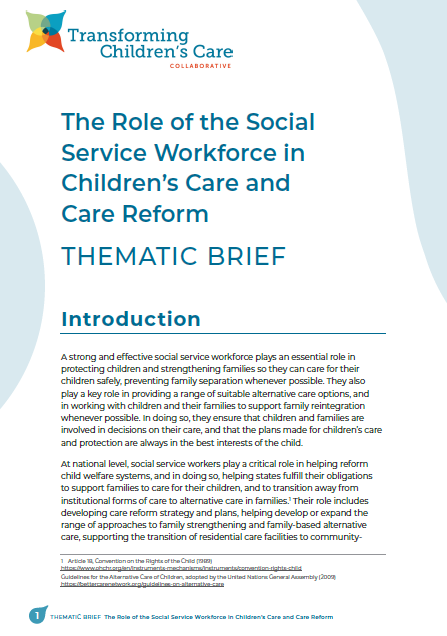
Thematic Brief: The Role of the Social Service Workforce in Children's Care and Care Reform
This brief was developed under the global Task Force on the Social Service Workforce in Care Reform of the Transforming Children’s Care Global Collaborative. It was developed to help government policy and decisionmakers understand the essential role of the social service workforce and how to strengthen that workforce in line with their national commitments to care reform and regional and global conventions. This brief includes high level guidance, recommendations and practical examples from diverse contexts for policy and decision-makers to consider in developing, supporting and strengthening the social service workforce.

Webinar: Strengthening the Social Service Workforce for Family Care: Global Insights
On October 22, we co-hosted a webinar with the Better Care Network (BCN) to explore progress, successes and challenges in global efforts to strengthen the social service workforce for family care and care system reform. During the webinar, we unveiled findings and recommendations from the above 2024 State of the Social Service Workforce Report: The Social Service Workforce in Family Care for Children. and thematic brief developed under the Transforming Children’s Care Global Collaborative. Then, through a moderated panel discussion, we heard insights on efforts to strengthen the social service workforce for family care in Moldova, India, Uganda, Guatemala and Jordan.